Designing Adaptive Learning Environments
-
Open online course · Starts Aug 23, 2027
Designing Adaptive Learning Environments Interaction, Personalization, and Analytics
How can a learning environment notice what a learner is doing and respond in a way that helps them learn? Study the learning science, the design of adaptation, and the analytics behind it, and build an adaptive learning prototype of your own.
15 weeksFree and open (CC BY 4.0)No programming requiredEnglish
Create your account and join Already registered? Open the course
Registration for this cohort is open until Sunday, September 5, 2027, for up to 40 learners (18+). After you confirm your email, open the course and select Enroll me.
How it works
- One module a week: a 6-7 minute pen-drawn lecture, a worked example of the same length, open readings, a discussion, and a practice check that explains every answer.
- Four design labs, each with a no-code and a code path: a rule-based adaptive lesson, knowledge tracing, instrumentation and features, and a dashboard.
- A studio project across the term: pitch it, specify its adaptations, pilot it with real users, then publish it openly.
- The course adapts too: a two-minute start-of-course check suggests a lab path for you.
Five units
- Unit 1: Foundations Modules 1–3
- Unit 2: Modeling learners Modules 4–6
- Unit 3: Designing adaptation Modules 7–9
- Unit 4: Learning analytics Modules 10–12
- Unit 5: Evaluate, govern, put into practice Modules 13–15
Build your own adaptive prototype
Across the term you design, build, pilot, and openly publish one adaptive learning prototype with an analytics plan. It can be a research prototype or a real course or product at work, made alone or in a pair. You pitch it in Module 2, specify its adaptations in Module 7, pilot it with real users in Module 13, and publish it under an open license in Module 15.
The Decision Canvas: before you log or show any data, a one-page worksheet asks what decision the data will inform, who acts on it, and how the data could lie.
Your instructor
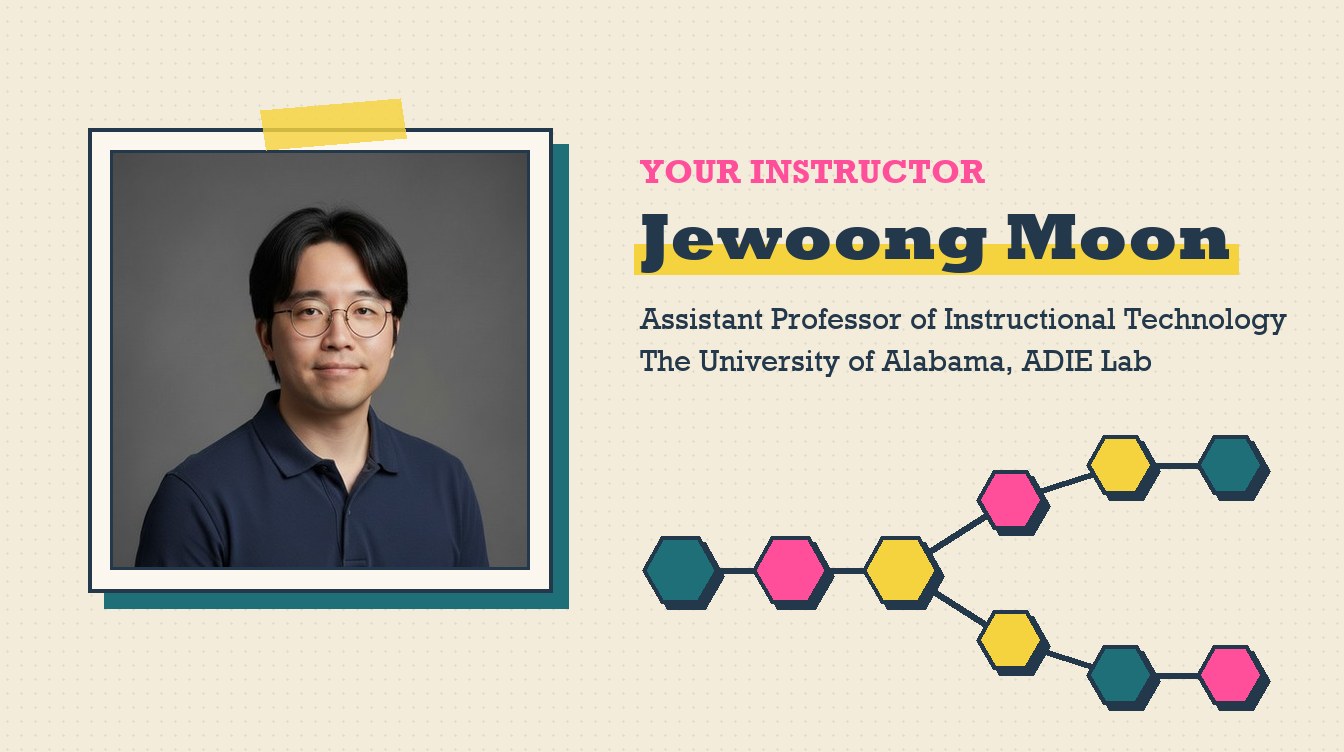
Jewoong Moon is an Assistant Professor of Instructional Technology in the Department of Educational Leadership, Policy, and Technology Studies at The University of Alabama, where he directs the ADIE Lab (Adaptive Design of Immersive E-Learning Lab).
His research covers digital game-based learning, inclusive and immersive (XR) learning design, learning analytics, educational data mining, and adaptive learning systems. This course draws on the adaptive and analytics side of that work: his lab builds learning games and simulations, studies what learners do inside them, and uses what it finds to make the next version teach better.
He earned his PhD in Instructional Systems and Learning Technologies at Florida State University (2021), and his MA and BEd at Chonnam National University in Korea. His immersive learning papers received Outstanding Paper Awards from the Immersive Learning Research Network (2023 and 2024), and he is an Associate Editor of Behaviour & Information Technology.
What you will be able to do
- Explain how interaction produces learning, using the ICAP and Knowledge-Learning-Instruction frameworks, and tell interactive learning apart from mere activity.
- Specify an adaptation by what is adapted, to which learner characteristic, at what time scale, and on what evidence, and reject unsupported bases such as learning styles.
- Build and compare learner models (knowledge components, knowledge tracing, and indicators of affect and self-regulation) from interaction data.
- Design adaptive feedback, hints, scaffolding, and sequencing, including generative-AI help with guardrails.
- Instrument a learning environment to capture interaction data (xAPI) and turn the data into features that answer a learning question.
- Design predictive models, dashboards, and open learner models that lead learners and teachers to useful action.
- Evaluate adaptive systems and analytics with sound comparison designs, and address fairness, privacy, transparency, and learner agency.
- Publish an adaptive learning prototype and its analytics plan as an open educational resource.
Questions
Who is this course for?
Graduate students, instructional designers and learning engineers, teachers and trainers, and edtech, L&D, and product staff who want to design adaptive learning or use learning analytics well. Advanced undergraduates are welcome.
Do I need to know how to code?
No. Every lab has a no-code path (Twine, spreadsheets, and paper or slide mock-ups) at full credit. If you like a little Python or JavaScript, each lab also has a code path; you can switch at any lab.
What do I need?
A computer with a current Chrome, Edge, or Firefox browser, and time each week (about 8 to 10 hours per module, as planned). Nothing to install until the lab that needs it.
What does it cost?
Nothing. Every required reading is open access, and every required tool is free or open source.
What do I get at the end?
A digital badge when you pass (60% or more) every lab, assignment, and knowledge check, and an adaptive learning prototype of your own, with its analytics plan, published under an open license.
Who can join, and how many?
Adults (18 or older). Each cohort is capped at 40 learners so every submission gets written feedback from the instructor: labs within a week, studio milestones within ten days. If the cohort is full, the Enroll me button will say so, and the next cohort's dates will be posted on this page.
Is it accessible?
Every lecture has a full transcript, and videos have captions as they are released. Every lab has a path that works with a keyboard and a screen reader. If a tool does not work with your assistive technology, an equivalent alternative will be arranged. See the accessibility section of the site policy.
This course is about learning analytics. Is my data analyzed?
Your name, email address, and course activity are used only to run the course: grading, feedback, and progress tracking. They are not used for research. One example dashboard in Module 12 shows this course's own completion data, anonymized and aggregated, with no names attached. See the site policy for details.
Designed and taught by Jewoong Moon · Course materials licensed CC BY 4.0 · Site policy and privacy · Accessibility